

BECOMING A CULTURALLY INTELLIGENT ORGANIZATION
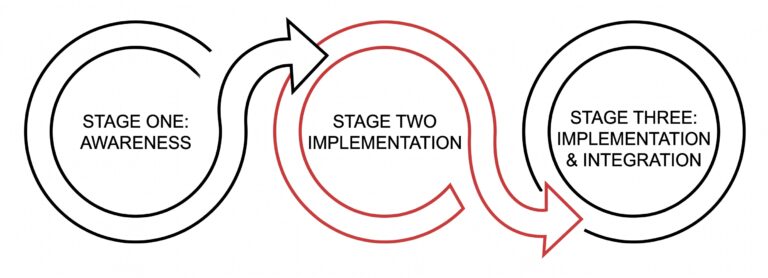
THREE STAGES IN DEVELOPING CULTURALLY INTELLIGENT ORGANIZATIONS
STAGE 1 AWARENESS
- Becoming aware of our own cultural patterns, and those of the organizations and people we interact with.
- Recognizing how we position ourselves, detecting subtle biases that condition our behaviour and the impact we have in every interaction.
- Understanding perception is subjective, learning how to question our perception and focusing on self development.
Training programs are the starting point to create Awareness in big groups within an organization.
STAGE 2 IMPLEMENTATION
Putting into practice strategies that will improve Collaborative and intercultural leadership. At this stage our natural reactions are still triggered under stress but we now can choose to approach situations differently. At this stage, it is clear that we have the tools and are able to approach situations differently achieving better results. However, strategizing at this stage may still feel mechanical. Reviewing, discussing and practicing real life cases and role plays help us integrate new behavioural patterns.
Training & Coaching speed up the Implementation stage.
STAGE 3 INTEGRATION AND FLOW
Diversity has become second nature to us. We no longer perceive situations in dualistic terms i.e good/bad, young/old, man/woman, black/white but have a solution focused approach.
Integration & Flow through Coaching.
Culturally Intelligent organizations work from a “pro-human” perspective and are solution focused, leave tags to the side, are flexible in their positionalities and communicate with each member of the community at an individual level focusing on the aggregate qualities team members bring to the table. Every interaction and negotiation is managed consciously and with a clear intention and purpose. Leaders who develop cultural intelligence build organizations that operate seamlessly across borders, unlock diverse perspectives, and create a competitive advantage in a globally connected world.
Culturally intelligent leaders go beyond the limitations of labels and binary thinking where gender, age, ethnicity, or race subtly influence judgment and decision-making. True cultural intelligence is grounded in objectivity and human potential: it prioritizes contributions, values diverse insights, and amplifies impact. The result is stronger cross-cultural communication, higher-performing multicultural teams, and organizations equipped to lead with agility in a global marketplace.
“Transformation occurs when the heart and mind are in line. It´s about connecting with the human side of the business”.
BENEFITS OF DEVELOPING CULTURALLY INTELLIGENT ORGANIZATIONS
Interpreting behaviours and interactions steming from cultural traits is a skill that can be learned and integrated in your day to day!
Leaders who are Culturally Intelligent and thrive in intercultural environments have an integrated mindset of Inclusiveness and a humanistic approach to business. They are usually good observers and good listeners who can interpret cultural differences and adapt their style to their audience. They are good at understanding the degree of protocols needed, timing, dynamics in relationships and adapt their communication style to the situation at hand. Mind and emotions are at a balance.
Cultural Intelligence improves team
· commitment
· adaptabilility in times of uncertainty
· creativity to solve challenging situations
· growth at a global scale
· trust, reliability & accountability
. energy and willingness to be part
Training, Coaching & Counseling Programs are adequate for companies and leaders that
· seek to have an international presence
· aim at becoming global
· manage multicultural teams
· have expat programs or are undergoing expat processes
· negotiate & communicate interculturally
· are undergoing a cultural change (mergers & acquisition)
TRAINER & TOOLS
Every process of becoming Culturally Intelligent is unique. Georgina Barquin works hand in hand with every one of her clients and observes key players & group dynamics, conducts key interviews and uses tools such as the Country Navigator, The Hawkins Model of Consciousness, The Barret Model or The Leadership Circle. Based on more than 20,000 hours of experience, she provides key pointers in order to help you in the transformation of your organization.
- Country Navigator provides a clear map on individual cultural profiles. Not everyone within the same culture will obtain the same profile. It is interesting to see where people within the organization may clash, what strengths they have and how to better combine their skills and approaches to reap the benefits of diversity within a team. Country Navigator is also useful for expats to understand local dynamics in comparison to their natural preferences.
- We use the Hawkins map of consciousness to help our clients and coachees visualise where they stand, what emotions are stopping them from developing their full potential and encouraging them to grow and develop further as key players in the development of the organization.
- The Barret Model provides clear insights into the level of alignment between individual values, current company values and the desired values. This tool provides a clear road map for a well founded Culture Change Management process.
- Leadership Circle Profile™ is a 360 Feedback tool that provides insights into key strengths and limiting behaviours and attitudes. Working from one’s strengths and shedding light on limiting behaviours triggers a person’s awareness and motivation to change.